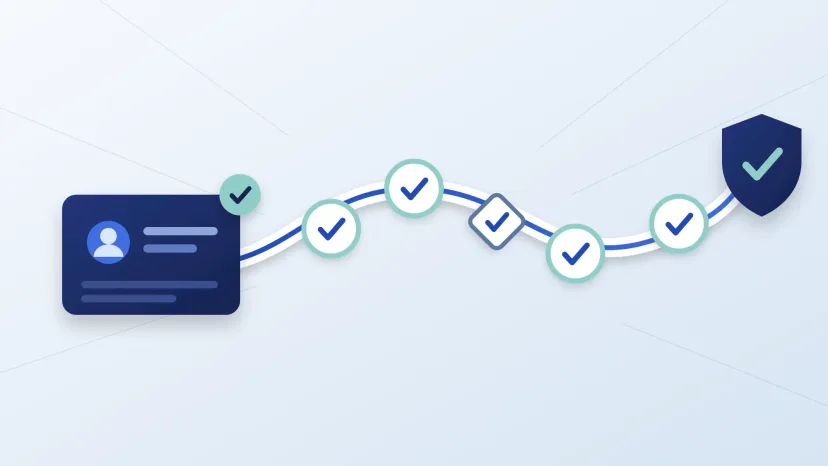
Our post on IAL3 re-verification cadence for FedRAMP Class D covered what happens after Day 1. FedRAMP's proposed Key Security Indicator KSI-IAM-MPI, Managing Personnel Identities, asks for the identity of personnel to be "persistently verified and validated," and a single onboarding check cannot show that.
This post is about the mistake at the other end of the timeline: starting too late.
We regularly speak with cloud providers that are building a FedRAMP 20x Class D (High) boundary, or moving a Rev5 High or Class C environment toward one, and that plan to run attended NIST SP 800-63A-4 IAL3 identity proofing as the last task before the independent assessment. On paper the order makes sense. The environment is still being built, it holds no federal customer data, and kits, scheduling and contractors can wait.
In practice it means the whole boundary is designed and built by people nobody has verified. Our answer to "when should we start IAL3?" is at boundary kickoff, before the first engineer gets access. Here is the reasoning, and a timeline that makes it workable.
When to start IAL3 for FedRAMP Class D, in brief:
- Start at kickoff. The people who build a Class D boundary handle its source code, infrastructure-as-code, IAM design and security documentation long before federal data arrives. IAL3 belongs in front of that access.
- A late check cannot undo early access. If someone fails or refuses attended proofing a few weeks before the assessment, removing the account does not recover what they saw, copied or changed in the months before.
- A fast rollout is possible and still a poor plan. A group of 100 can finish in about a month. Under audit pressure, that month produces spreadsheets in place of integrations, friction with employees, and delays from expired documents and international shipping.
- 20x rewards an early start. Class D providers validate each indicator with at least four automated methods, and RFC-0036 proposes metric data every 4 hours. That history only builds forward, and FedRAMP's move of the Class D pilot to January 2027 gives teams that start now more of it.
The Pre-Audit Crunch: A Boundary Built Before Anyone Checked Who Was Inside
We see the same pattern at startups entering the federal market and at established SaaS vendors moving up to FedRAMP High. A team spends six to twelve months standing up the environment: writing Terraform modules, federating the identity provider, hardening CI/CD pipelines, drawing architecture diagrams and assembling the Security Decision Record. Four to six weeks before the assessment window, someone raises NIST SP 800-53 IA-12(4), in-person validation and verification of identity evidence, and the proposed KSI-IAM-MPI. Identity proofing becomes a fire drill.
The scheduling pressure is the smaller problem. The larger one is finding out, at the last moment, that someone who has worked inside the boundary for months cannot pass attended IAL3, or will not try. Consider what follows when a person is denied, keeps postponing, or resigns quietly instead of sitting down at a controlled IAL3 Kit in front of a trained proofing agent:
- The boundary has already been exposed. No federal customer data may have entered the environment, but that person has seen what an attacker wants most: source code, infrastructure-as-code templates, how secrets are managed, firewall rules, network topology, vulnerability reports and security documentation.
- The cleanup has no clear end. Removing an unverified user two weeks before an assessment fixes the headcount spreadsheet. The security team still has to review every commit, IAM policy change, container image and API token that person touched over the previous months, at the point when engineering should be finishing assessment readiness.
- The risk carries into production. What someone learned about the architecture and controls during the build stays useful after go-live. A person who mapped the boundary during standup holds a plan for attacking it once agencies are using it.
Treating IAL3 as a final checkpoint assumes that everyone on the roster is who they claim to be and only the paperwork is missing. IAL3 exists because that assumption is not safe.
Damage Takes Hours: Why Contractors and Standup Builders Cannot Wait
A fair question comes up in early planning: "We are not handling federal data yet, and half the people helping us stand this up are contractors, consultants or short-term engineers. Does FedRAMP require all of them to be proofed at IAL3 during the build?"
IAL3 itself is settled. FedRAMP High requires IAL3, and Class D will not ask for less. What the rules do not name is the day: no FedRAMP rule says at which point in a pre-production build each temporary builder must be proofed. That gap is where teams cut corners.
Our advice is not to use it. Treat attended IAL3 as the front door from the day boundary design and engineering begin, for short-term contractors and implementation partners as much as for employees.
The reason is how little time an attacker needs. Nobody needs a two-year tenure or live agency data to do lasting harm. A few hours of legitimate access is enough to copy repositories, collect secrets, study the defenses or leave a foothold. Three cases show how short the window is:
- On delivery of the laptop (KnowBe4, July 2024). A North Korean operative passed four video interviews, reference checks and a background check using a stolen U.S. identity and an AI-enhanced photo. KnowBe4's own account says of the company workstation that "the moment it was received, it immediately started to load malware." Its security operations team contained the device about 25 minutes after the first suspicious activity was detected. No data was lost, and KnowBe4 credits the fact that new employees start "in a highly restricted area" with "no access to production systems."
- Almost immediately after the start date (Secureworks, 2024). Secureworks researchers described a fraudulently hired contractor who "exfiltrated proprietary data almost immediately after starting employment in mid-2024," as The Record reported. After the company ended the contract for poor performance, it received emails with proof of the stolen data and a ransom demand.
- At industrial scale (Justice Department, October 2026). On October 13, 2026, the Justice Department announced an indictment in Ohio charging 14 people in a scheme that affected more than 70 U.S. companies. The same announcement covered Operation Lonestar Roundup, in which the FBI carried out searches and other law enforcement action at more than 40 Texas residences known or suspected to be laptop farms, and seized about 187 laptops and KVM devices. The FBI's announcement the same day recommends "identity in depth," which includes "continuous identity verification throughout employment."
Contractors are often the easiest way into a new boundary. They are brought in quickly to meet a milestone, given broad administrative rights to stand up infrastructure, and rarely vetted as thoroughly as permanent staff. Someone who takes a six-week contract during the build does not need to wait for your certification. By the time the compliance team prepares for the assessment, they have left, with a working knowledge of your architecture and code.
The KnowBe4 case also points to the remedy. Its new hire could reach nothing that mattered. For a Class D build, the equivalent is that nobody reaches the boundary's code and design until they have been proofed. Our report on North Korean IT workers and laptop farms covers the wider pattern.
New Class D Boundaries and Teams Moving to FedRAMP 20x
The right start date depends on where you begin, and three facts apply to everyone.
- The pilot has moved. In a notice dated November 16, 2026, FedRAMP said it had "delayed the 20x Class D pilot until January 2027," that the dates posted earlier are "no longer valid targets," and that it will announce updated timelines, expectations and the scale of the pilot by mid-December 2026.
- The new indicators are still a proposal. RFC-0036, which proposes KSI-IAM-MPI, closed for comment on November 19, 2026, and the final pilot requirements are not out. FedRAMP has said the rules developed in the pilot will go into its Consolidated Rules for 2027.
- IAL3 is not in question. FedRAMP High already calls for identity, authenticator and federation assurance at level 3. IA-12(4), a High-only control and one of KSI-IAM-MPI's related controls, requires identity evidence to be validated and verified in person, which in NIST SP 800-63A-4 is IAL3. Class D is the High tier of FedRAMP 20x and has to be at least as strong as the baseline it succeeds, so it will not accept less. Our RFC-0036 breakdown covers the indicator in full.
Building a new 20x boundary
A greenfield team has an advantage that established providers do not: nobody has access yet, so nobody has to be brought in after the fact.
Under the proposed FRC-CLD-PCD, a provider outside the pilot must hold a 20x Class C certification "without corrective action for at least 6 months" before applying for Class D, unless FedRAMP grants an exemption for an urgent critical need. That progression is a built-in runway:
- Put attended IAL3 in place when the boundary build starts, before Class C is granted.
- Make sure the first cloud organization administrators, Terraform authors and security engineers are proofed at IAL3 and hold phishing-resistant hardware authenticators before production tooling is provisioned.
- When the Class C period ends and you apply for Class D, every privileged person in the boundary has a record that goes back to the first day of the build.
Moving from Rev5 High or Class C to 20x Class D
A provider with a Rev5 High (Class D) certification keeps it. FedRAMP's note on the proposed rule says no one "will be expected to give up their Class D Certification," but a move to 20x Class D still goes through 20x Class C first.
For an established provider, the timing problem is drift:
- Old proofing. Engineers hired years ago may have been proofed under an earlier process, verified at IAL2 on their own webcam, or never proofed at IAL3 at all. NIST SP 800-63A-4 makes IAL3 on-site attended, at a location and on devices the provider controls, so a session on an unmanaged personal device cannot meet it.
- An unclear edge. Support teams and contractors who touch monitoring, ticketing or shared tooling often sit in an undefined zone around the boundary.
- Missing history. FRC-CSX-VVK already requires Class D providers to validate each indicator with at least 4 automated methods, and the SDR-CSX-KMT rule as revised by RFC-0036 adds metric data every 4 hours for up to the past year, where available.
History is the part that cannot be bought. As we wrote in five automated IAL3 validation methods for Class D, it "accumulates only forward." The current rule lets a provider apply for initial certification with the mechanisms in place and an agreement to meet the requirement. A team that started its IAL3 rollout and its ledger checks months earlier arrives at assessment with operating evidence in place of a promise, and the pilot's delay adds months that can be used for exactly that.
Why "100 People in a Month" Is Not a Plan
We are often asked how fast an IAL3 rollout can go when an assessment date is close.
With more than 200 controlled IAL3 units, shipped kits and office kiosks, we can take a group of 100 employees and contractors through attended NIST SP 800-63A-4 proofing in roughly 30 days. That pace holds only if leadership stays on it, HR follows up on every appointment daily, and everyone has valid documents ready.
That it can be done in a month is no reason to plan for a month. When IAL3 is compressed into one high-pressure sprint, four things tend to go wrong:
- The integration is rushed. IAL3 status should feed identity provider access policy, PAM workflows and the automated validation pipeline. Under deadline, teams settle for spreadsheets and evidence folders, which cannot produce 4-hour metric data.
- Authenticator binding is separated from proofing. The attended session is the best moment to bind a person's phishing-resistant hardware authenticator, because the proofed person is demonstrably the one holding the key. Trust Swiftly binds it in the same session. Rushed rollouts often enroll keys separately, and an assessor will ask how you know who received each one.
- Employees push back. Across thousands of IAL3 sessions, employees who arrive wary take about 50% longer than those who know what to expect. A surprise identity mandate with a 72-hour deadline produces skepticism, rescheduling and escalations to HR and security.
- Edge cases hold up the finish. The attended session typically takes 3 to 10 minutes once the kit or kiosk is in front of the person. The calendar time goes to everything around it: expired passports, people without a chip-enabled passport who need a different combination of evidence, legal names that changed after marriage, travel, and missed deliveries.
When a sprint cannot be avoided, our mass onboarding guide covers how to run a large group well.
International personnel need more lead time
If anyone in the boundary workforce, or in the wider engineering and contractor roster, is outside the United States, an early start stops being a preference.
IAL3 Kits ship to all 50 U.S. states and 32+ countries. Canada and 30 countries across Europe are pre-approved, and most other countries our international carriers serve are available on approval. International proofing still has steps that cannot be compressed:
- Documents. A valid chip-enabled passport, read over NFC on the controlled kit, is the quickest route through evidence validation. Finding out two weeks before an assessment that an overseas contractor's passport has expired can hold up that person's verification for months.
- Transit and customs. A domestic kit arrives in days. An international shipment clears customs in both directions and depends on local courier schedules and public holidays.
- A private location and a time. We run IAL3 only at approved private locations: a company office, a private office or a home office, never a café or an open coworking floor. Matching live agent availability to a private space across time zones takes notice.
- Scope. RFC-0036 also proposes four indicators on foreign ownership, control or influence (FOCI), one of which asks providers to persistently review foreign persons able to direct or decide matters affecting the offering. Looking at your international footprint early settles the design question before it becomes urgent: verify the people who need access inside the boundary, and keep everyone else technically outside it.
An IAL3 Rollout Timeline for FedRAMP Class D
Build IAL3 into the boundary's lifecycle from kickoff. This is the phased model we recommend to greenfield teams and to providers moving to 20x Class D. Adjust the months to your headcount. The order is what matters. The tiers are the three risk tiers from our re-verification cadence guide: Tier 1 for people who can change the boundary alone, Tier 2 for standard privileged engineers and operators, and Tier 3 for tightly scoped access.
| Phase | When | Who and what | Gate to pass |
|---|---|---|---|
| Phase 0: Scope and policy | Boundary kickoff, 6 or more months before assessment | List every in-boundary role: employees, contractors, short-term standup engineers and third-party operators. Assign each a tier. Record where people are located and whether their passports and IDs are valid. Write the retention and privacy policy. | A written boundary population, with identity provider gating rules and the Security Decision Record policy drafted. |
| Phase 1: Tier 1 and core builders | Months 1 to 2 | Proof Tier 1 first: cloud architects, organization and IAM administrators, security engineers and lead contractors. Place office kiosks at the main sites and send international kits out first. | No unverified Tier 1 administrator in a cloud console, IaC repository or CI/CD pipeline. |
| Phase 2: Full workforce and automation | Months 2 to 4 | Proof Tier 2, Tier 3 and the remaining contractors. Bind hardware authenticators in the session. Start four or more automated validation checks on a 4-hour cycle. | Every active boundary identity verified, and metric history building in the Security Decision Record. |
| Phase 3: Steady state | Month 4 onward | Gate every new hire, contractor and role transfer before access. Connect risk signals under SI-4(19) and the proposed KSI-IAM-MST, and schedule re-verification for each tier. | The status of every identity is known at any moment, with nothing to reconstruct for an assessment. |
Urgent hires: a sandboxed lane that keeps the gate closed
A realistic program plans for urgency. A senior engineer accepts an offer and needs to start Monday, before an IAL3 Kit can reach their home office.
Do not grant temporary boundary access on trust. Run a separate onboarding lane:
- Same day. The new hire completes an IAL2 check on the same platform. It covers HR onboarding, training, corporate email and orientation, and it is recorded as IAL2.
- Until the kit arrives. The account stays out of boundary cloud consoles, source code repositories, IaC, production and staging environments and Class D system documentation. Group membership enforces this, so it does not depend on anyone following an instruction.
- When the kit arrives. The attended session takes place, the hardware authenticator is bound, and the IAL3 record is what adds the person to boundary groups.
The start date holds, and no unverified person sees boundary material in the meantime. Our post on same-day IAL3 covers how quickly a first session can be arranged.
Keeping the Gate Closed: Continuous Gating Under KSI-IAM-MPI
An early start gives you a clean boundary. Continuous gating keeps it clean after launch.
"Persistently" is a defined term in FedRAMP's rules. Persistent activities repeat in cycles that are "intentional, understood, and documented," and "the status of persistent activities will always be known." A process that depends on HR remembering to send a calendar invitation when someone changes teams does not meet that. Four controls do.
1. Make IAL3 status a technical prerequisite in the identity provider
Access to every boundary resource, including cloud accounts, Git repositories, CI/CD runners, PAM vaults and Class D documentation, should depend on policy. Before a person is added to a boundary group, provisioning checks for three things:
- a valid, signed record of an attended NIST SP 800-63A-4 IAL3 session;
- a verification date inside the window for the person's tier; and
- a phishing-resistant AAL3 hardware authenticator bound to that proofed identity.
Without all three, the person is not a member of the group.
2. Reconcile every access path against the ledger, every 4 hours
FRC-CSX-VVK expects at least four automated methods per indicator at Class D, and RFC-0036 proposes metric data every 4 hours. A single HR attribute cannot carry that. Whatever methods you choose, they have to cover every place where an identity can hold boundary access:
- identity provider boundary group members, checked against the IAL3 proofing ledger;
- cloud IAM and PAM privileged principals, which catches local and break-glass accounts created outside the identity provider;
- source code and CI/CD collaborators, especially contractors; and
- the age of each proofing record and the integrity of each authenticator binding.
When a contractor is added directly to a repository, or an administrator's re-verification window lapses, the next sweep flags it and access is suspended until it is resolved. Our five automated IAL3 validation methods describe each check and the metric it reports.
3. Put end dates on contractors and temporary access
Temporary access tends to become permanent. To stop that:
- Give every contractor and consultant identity an expiry date from Day 1.
- Send any extension or re-engagement through the same gate. When a contractor returns months later, re-verify them against the biometric retained from their first session before restoring access.
- In each periodic access review, check tier assignment and IAL3 window status in the same pass.
4. Pair the entry gate with scheduled and event-driven re-verification
The entry gate establishes who came in. Persistent verification establishes that the same person is still the one using the access. As our re-verification cadence guide sets out, an attended IAL3 re-verification should come before access continues or expands in four situations:
- Privileges increase. A Tier 2 or Tier 3 user moves into a Tier 1 administrative role.
- An authenticator is lost or replaced. Recovery is gated by a biometric comparison against the retained Day 1 sample, which defeats a social-engineered help desk reset.
- A borderline risk signal appears. Under SI-4(19) and the proposed KSI-IAM-MST, a sign-in that does not fit the approved work location, remote-access software with a plausible explanation, or drifting work hours calls for a quick attended session as one more datapoint. Clear evidence of compromise goes straight to incident response.
- A tier window expires. Every 1 to 2 years for Tier 1, every 3 years for Tier 2, and every 5 years with random sampling for Tier 3.
What to Put in Your Security Decision Record
An independent assessor reviewing a 20x Class D package will look past the policy statement to when the control took effect and how it prevents unverified access today. Record these six things:
- The standup gating policy. Which boundary artifacts are protected before federal customer data arrives (source code, IaC, architecture documents, CI/CD and consoles) and the date IAL3 became a condition of access to them.
- Contractor and temporary scope. How short-term engineers, implementation partners and third-party operators are proofed before access, with no exception for standup roles.
- The sandboxed lane, if you use one. The technical controls that keep an IAL2-only hire out of boundary systems until attended IAL3 and authenticator binding are complete.
- International proofing and scope. The evidence you accept, the kit chain of custody, and how people outside the boundary are technically kept outside it.
- Automated validation and the metric. The four or more automated methods under FRC-CSX-VVK, the 4-hour cycle, and the metric you report: the percentage of in-boundary identities with a valid IAL3 record inside its window.
- Failures and lapses. What happens when someone fails proofing, declines a re-verification or passes their window: access is suspended, and what that person changed is reviewed if they already had access.
Frequently Asked Questions
Does FedRAMP Class D require IAL3?
Yes. FedRAMP High already calls for identity, authenticator and federation assurance at level 3, and IA-12(4), a High-only control, requires identity evidence to be validated and verified in person, which in NIST SP 800-63A-4 is IAL3. The proposed KSI-IAM-MPI lists IA-12(4) as a related control and adds that personnel identity is verified persistently. Class D is the High tier of FedRAMP 20x and has to be at least as strong as the High baseline, so nothing less than IAL3 will meet it.
Do we need IAL3 before any federal customer data enters a Class D boundary?
Yes, in our view. IAL3 is required for the boundary, and the only open point is the day it starts, because no FedRAMP rule names the day of a build on which each builder must be proofed. We recommend kickoff. Everyone working on a Class D build handles source code, cloud configuration, IAM policy and security documentation. If an early builder turns out to be unable or unwilling to pass IAL3 just before the assessment, removing the account does not undo the access, and the team is left with a retroactive investigation.
Can we verify 100 employees and contractors in the 30 days before an assessment?
It can be done: with enough controlled kits and kiosks and daily follow-up, 100 attended sessions fit in about a month. We advise against planning on it. A sprint tends to leave spreadsheet integrations, authenticators enrolled apart from proofing, employee pushback, and stalls from expired documents and international shipping. It also leaves little automated validation history to show for FedRAMP 20x Class D.
Do temporary contractors and consultants need IAL3 during boundary standup?
In our view, yes, before they receive access. Short-term roles are onboarded fast, hold broad rights and get less vetting than permanent staff, and public cases show that damage can be done within hours of access. A contractor who touches boundary code, infrastructure or security documentation should complete attended IAL3 first.
How early should we plan IAL3 for international employees or contractors?
At project kickoff, ideally four to six months before the target assessment or transition date. International proofing needs passports checked for validity early, time for kits to cross borders and clear customs in both directions, sessions scheduled across time zones at approved private locations, and an early decision on which roles belong inside the boundary.
How does early IAL3 help a provider moving from Rev5 or Class C to 20x Class D?
As proposed, a provider outside the pilot holds 20x Class C for at least six months without corrective action before applying for Class D, and a Rev5 High provider still moves through 20x Class C. That period can be used to bring long-serving staff onto attended NIST SP 800-63A-4 proofing, retire checks done on personal webcams, and run four or more automated validation methods on a 4-hour cycle, so the Class D review starts with operating history.
Has the FedRAMP 20x Class D pilot been delayed?
Yes. In a notice dated November 16, 2026, FedRAMP said it had delayed the 20x Class D pilot until January 2027 and that the dates posted earlier are no longer valid targets. It expects to announce updated timelines, expectations and the scale of the pilot by mid-December 2026. The delay does not change when to start IAL3, because validation history only builds forward.
What if an urgent hire needs to start before their IAL3 Kit arrives?
Use a sandboxed onboarding lane. The hire completes an IAL2 check for HR, training and corporate email, with no access to source code, cloud consoles, IaC or Class D documentation. Boundary access is added only after the kit arrives, the attended IAL3 session is complete and a hardware authenticator is bound.
The Bottom Line: Put the Front Door Up Before You Build the House
For a FedRAMP Class D boundary, identity proofing is the front door, and a door fitted after the house is built has already let everyone in.
Leaving IAL3 to the last weeks before an independent assessment is a bet that every engineer, administrator and contractor who spent months reading your code and configuring your cloud was who they said they were. Attackers have shown they can act within hours of receiving a laptop, and FedRAMP 20x measures identity controls continuously, so the bet is a poor one.
Start IAL3 at boundary kickoff. Plan ahead for contractors and international staff. Connect verification status to the identity provider and to 4-hour validation, and pair the entry gate with a risk-tiered re-verification cadence. Done in that order, IAL3 is the first control the boundary has, and no longer the last obstacle before the assessment.
Standing up a FedRAMP Class D boundary, or planning a move to FedRAMP 20x?
- Trust Swiftly delivers attended NIST SP 800-63A-4 IAL3 on controlled IAL3 Kits and office kiosks, with coverage in all 50 U.S. states and 32+ countries, for kickoff gating, contractor proofing and re-verification.
- Read the companion posts on IAL3 re-verification cadence and what RFC-0036 proposes.
- Talk to our IAL3 team about your rollout timeline.