Trust Swiftly Is The Complete IAL3 Solution
Forward-thinking organizations should not build high-assurance identity around travel, appointment queues, or domestic-only station coverage. Trust Swiftly brings the controlled IAL3 environment to the user with minimal-footprint kits, global reach, in-office deployment, and practical re-verification for modern remote workforces.
Need the technical workflow? See the IAL3 verification solution.
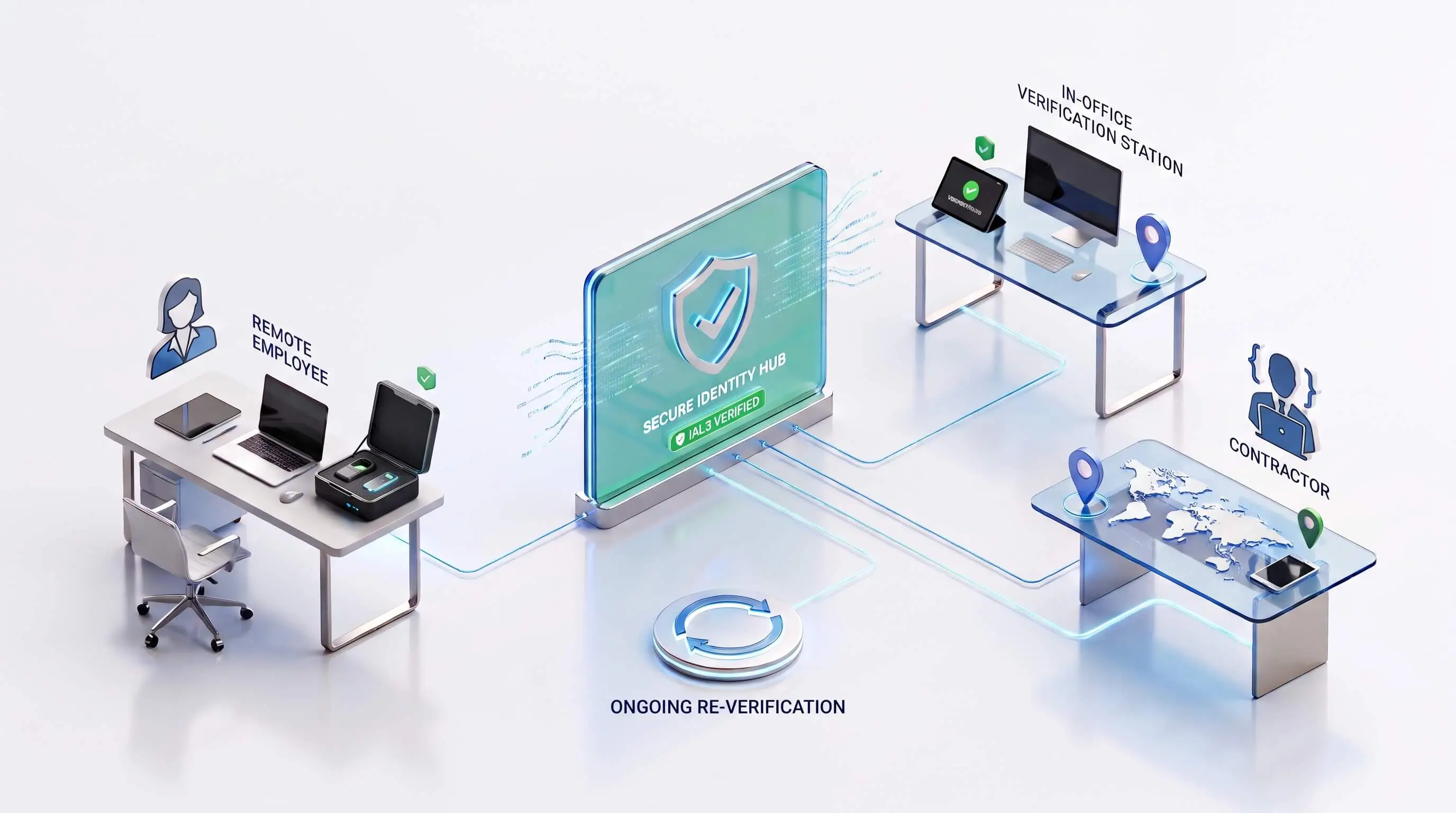
Deliver the Secure Environment
Ship controlled, minimal-footprint kits to the employee's home, approved office, or international location instead of routing people to fixed public stations.
Verify Where Work Happens
Confirm identity and approved physical presence at the actual work location, not merely that a person appeared at a generic counter.
Complete Scheduling Control
Users schedule and reschedule through the portal, choosing times that minimize disruption without waiting for availability.
Make Re-Checks Realistic
Use in-office and at-home kits for recurring, random, or risk-triggered re-verification so proxy-employee controls do not stop after onboarding.
The Right Way to Operationalize IAL3
IAL3 should strengthen security without creating a travel program. The better model brings supervised proofing, device control, and evidence capture to the workforce.
| Operational Challenge | Station-Bound Legacy Model | Trust Swiftly Best Practice |
|---|---|---|
| Workforce Location | Constrained to fixed physical stations, often domestic-first or domestic-only. Overseas developers, contractors, and subsidiaries become exception cases. | Global Compliance Coverage: Kits deploy across all 50 US states and 32+ countries, including home and in-office locations where proxy-identity risk is highest. |
| Employee Effort | Requires travel, appointment scheduling, public waiting areas, and manager follow-up. In large or rural states, fixed-site proofing can become an all-day trip, including 8+ hours of round-trip travel for some users. | Zero Travel. Zero Delays. The secure environment is delivered to the doorstep, cutting onboarding friction from weeks to days. |
| End-User Experience | Sensitive identity proofing happens in a public or shared location where surrounding activity, overheard conversations, and rigid appointment windows create user friction. | Complete Scheduling Control: Users schedule and reschedule through the portal, choosing private, convenient sessions that minimize disruption to busy workdays. |
| Urgent Onboarding | Backlogs and appointment windows slow down high-priority hires, privileged users, and customer escalations. | IAL2 Fast Path Plus Attended IAL3: Route urgent cases immediately while the supervised IAL3 session is scheduled and completed. |
| Proxy-Employee Risk | One-time proofing is too static. Sending an employee back to a public station every six months, or at random, is not operationally realistic. | Portable Kits Make Lifecycle Proofing Possible: In-office and at-home deployments support routine, out-of-cycle, or risk-triggered re-verification. |
| Security Control | Public or shared proofing counters add custody, tampering, and availability questions that are difficult to inspect after every session. | Controlled Kit Integrity: Open chain of custody, cryptographic device verification, and physical inspection after use. |
Best-Practice Criteria for High-Assurance Programs
Use these requirements to defend the program internally, brief auditors, and keep procurement focused on outcomes.
| Criterion | What the program should require | Trust Swiftly |
|---|---|---|
| Coverage & reach | Proofing available wherever your people actually work: home, office, rural regions, all US states, and international locations. | Kits in all 50 states and 32+ countries; at-home and in-office deployments for distributed workforces. |
| Logistical agility | On-demand deployment that avoids appointment backlogs, public queues, travel reimbursement, and employee downtime. | Direct-to-user kit delivery for home or office proofing with zero required travel. |
| End-user experience | Self-service scheduling, easy rescheduling, and a private proofing environment that respects busy work schedules and sensitive verification moments. | Complete Scheduling Control: users manage sessions through the portal and complete proofing in a private home or office setting. |
| Urgent path | A fast track for time-sensitive cases, since attended IAL3 is supervised and cannot behave like instant remote KYC. | IAL2 runs in parallel as pre-enrollment and quick-turnaround path alongside attended IAL3. |
| Re-verification | Recurring and out-of-cycle checks that can be executed after onboarding when proxy-employee or insider risk changes. | Portable home kits and in-office kits make random or periodic re-verification practical. |
| Physical presence | Confirm where the person actually is and whether the user is at an approved work location. | Verifies the user's actual home or office location and approved physical presence. |
| Supply-chain security | Verifiable hardware integrity, chain of custody, and repeatable inspection. | Open chain of custody, cryptographically verified devices, and physical inspection after every verification. |
| Evidence breadth | Modern evidence collection for more applicants and cleaner assessor review. | mDL plus multiple strong evidence documents and supervised session records. |
| Integration & oversight | Fits IAM, HR, and ATS systems with complete evidence and review oversight. | Native IAM / HR / ATS integration and centralized session oversight. |
| Independent validation | Evidence of security beyond a sales deck or certificate badge. | $100K bounty program with zero bypasses; SOC 2 Type II + ISO 27001. |
Do Not Accept a Weaker IAL3 Operating Model
These are the assumptions that make high-assurance programs expensive, slow, and difficult to repeat.
Do not make geography the hidden control.
Best practice: Coverage should reach the workforce, including international contractors and remote users. A domestic station footprint is not enough for modern enterprise teams.
Do not turn IAL3 into a travel program.
Best practice: Bring the controlled environment to the user. Travel, queues, and appointment scarcity create security exceptions and slow onboarding.
Do not stop after the first proofing event.
Best practice: Proxy-employee and insider-threat programs need recurring and out-of-cycle re-verification that can happen quickly in office or at home.
Do not equate larger hardware with stronger security.
Best practice: Security comes from custody, cryptographic verification, inspection, and auditability. Bulky rigs add operational burden without proving better assurance.
Do not rely on a public location as the proof.
Best practice: Presence assurance should connect the verified person to their approved work location, not merely to a shared proofing site where sensitive verification can be overheard.
Do not make scheduling the user's problem.
Best practice: Give users portal-based scheduling and friction-free rescheduling so IAL3 fits around work, travel, and caregiving obligations.
Do not buy a logo without the evidence package.
Best practice: Ask for SOC 2, ISO 27001, bounty results, chain-of-custody records, device integrity evidence, and session-level audit trails.
High Assurance Has to Continue After Hiring
The proxy-employee problem is a lifecycle risk. A person can pass interviews, complete initial checks, and later hand access to someone else, work from an unapproved location, or use a local front for a remote operator. A one-time station visit is not enough.
Trust Swiftly makes repeat checks operationally realistic: keep kits in office for fast recurring sessions, ship kits to approved remote worksites, and trigger re-verification when risk signals change.
- In-office kits let security and HR run quick recurring checks without sending users to public stations.
- At-home kits validate remote workers at the approved work location without travel.
- IAM / HR / ATS integrations support risk-triggered proofing, contractor reviews, and privileged-access recertification.
Enroll with supervised IAL3
Capture identity, document, biometric, location, and device integrity evidence in a controlled session.
Bind assurance to the workforce record
Connect proofing evidence to HR, IAM, or ATS context so security teams know who was verified and where.
Re-check when risk changes
Use portable kits for periodic, random, or event-driven proofing without rebuilding the logistics plan.
What “More Secure” Actually Means
Physical assurance is verifiable, not assumed. Demand controls your auditors and security team can inspect.
Cryptographically verified supply chain
An open chain of custody and supply-chain audit, with every piece of hardware cryptographically tied and verified end to end. No opaque builds from unknown vendors.
Inspected after every verification
Each kit is physically inspected after every session, so integrity is re-established before the next use and tamper exposure does not accumulate.
Independently proven
Security you can audit: independently tested through a $100,000 bounty program with zero successful bypasses, backed by SOC 2 Type II and ISO 27001.
Verify the Person at the Approved Location
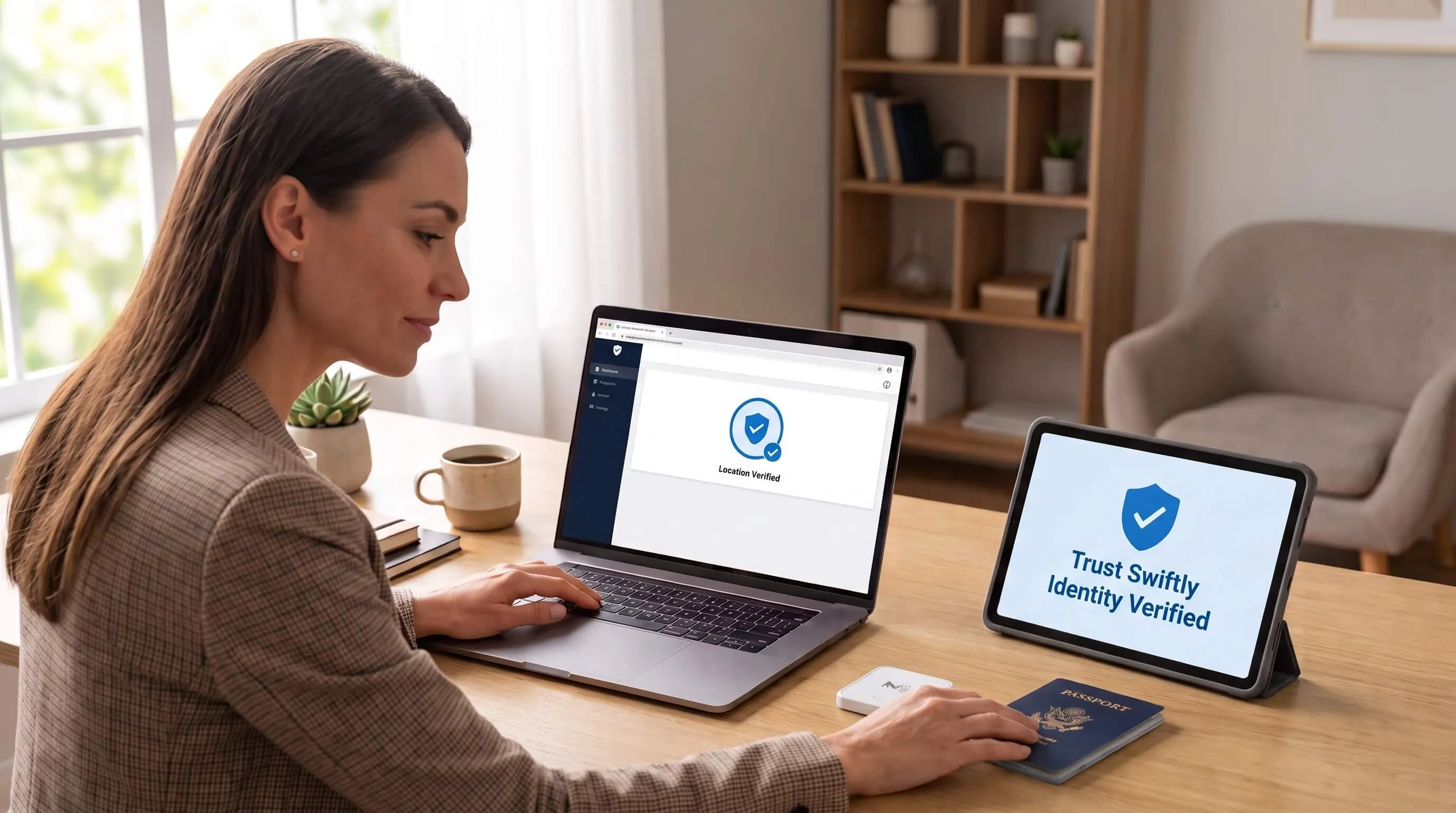
Most IAL3 approaches confirm who a person is. Trust Swiftly also helps confirm where they are: the user's actual office, home, or approved work location, captured in a defensible supervised session.
- Confirms approved physical presence instead of generic attendance at a public location.
- Flexible kits deploy to the office or the employee's home: zero travel, quick availability, minimal footprint.
- Every kit is inspected after use, so location and identity evidence stay tied to controlled hardware.
Coverage That Reaches the Whole Workforce
IAL3 should not exclude someone because they are remote, disabled, rural, traveling, or outside a domestic station footprint.
For some remote employees, a station-based model can mean hours of driving before the proofing even begins, including 8+ hours of round-trip travel in hard-to-reach regions. Trust Swiftly removes that barrier by bringing the controlled session to the user.
Frequently Asked Questions
Make Trust Swiftly Your IAL3 Standard
Bring your workforce map, risk tiers, and compliance requirements. We will show how Trust Swiftly covers home, office, international, urgent, and recurring IAL3 workflows without forcing your people into a station-bound model.