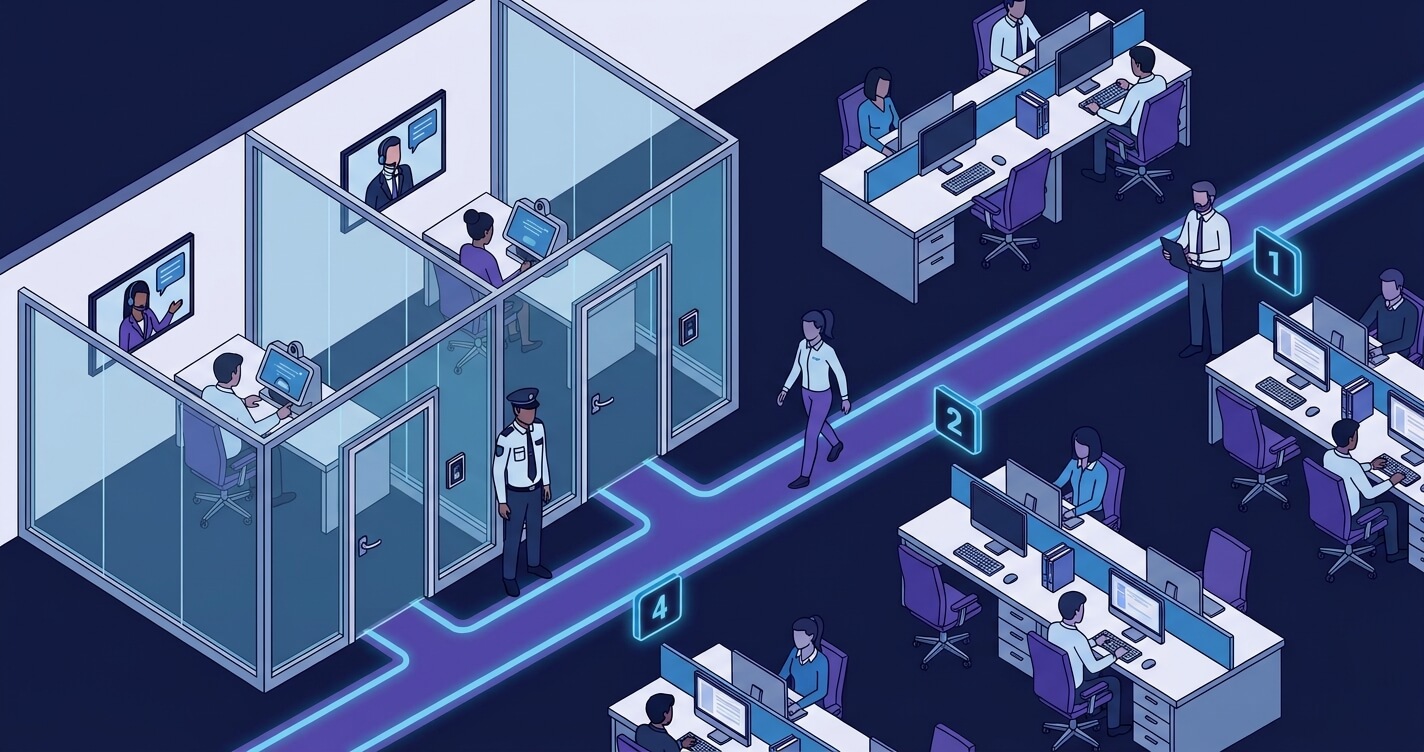
A common challenge for organizations requiring Identity Assurance Level 3 (IAL3) is the need to verify large volumes of employees quickly and securely. The trigger is rarely a slow strategic initiative. More often, a gap in IAL3 alignment surfaces during an internal audit, a 3PAO assessment, or a federal agency review, and suddenly a population of hundreds of engineers, administrators, and support staff needs high-assurance proofing on a remediation timeline measured in weeks, not quarters.
IAL3 cannot be closed with an email campaign. Under NIST SP 800-63A-4, Level 3 proofing is an attended event: the applicant is present in person or in a supervised remote session, their identity evidence is validated down to its cryptographic chip or against authoritative sources, and the person is biometrically matched to the document they present. That makes mass IAL3 enrollment a logistics problem as much as a software problem — and the organizations that close findings fastest are the ones that treat it that way.
In mass onboarding scenarios, relying on a single permanent kiosk or shipping individual verification kits to every employee can be logistically complex and costly. Kits are the right answer for a distributed workforce, but when most of the affected population badges into the same three or four buildings every week, the most efficient path to bulk enrollment is different: hosting dedicated on-site IAL3 enrollment events.
Why Mass IAL3 Enrollment Breaks the Usual Playbook
Start with the arithmetic. An attended IAL3 session with a prepared applicant — documents in hand, session running smoothly — typically takes several minutes of active verification time. At roughly seven to eight minutes per session, a single station clears 50 to 60 people in a working day, and that assumes the kiosk never sits idle. A 600-person audit finding routed through one permanent station is a multi-month remediation, with the audit clock running the entire time.
The two default alternatives both strain at volume:
- Sending everyone to a fixed verification site turns a compliance program into a travel program. Every hour an engineer spends commuting to a proofing location is productivity lost, and scheduling hundreds of individual trips creates its own administrative tail.
- Shipping a kit to every individual solves the travel problem elegantly for genuinely remote staff — it is the backbone of supervised remote identity verification — but at a dense corporate campus it means hundreds of shipments, returns, and chain-of-custody records for people who already sit two floors from a conference room.
The event model inverts the logistics: instead of moving people or shipping hardware to individuals, you move a small number of verification kiosks to where the population already is.
Designing a High-Throughput IAL3 Event
To minimize business disruption, organizations can stand up temporary verification hubs at centralized corporate offices or agency locations for a defined enrollment window — a few days to a couple of weeks, sized to the population.
The most effective deployment model borrows security infrastructure the facility already has:
- Controlled access. Holding events in a private office or reserved room already gated by physical access controls — badge readers, reception, security staff — layers the proofing environment on top of controls your physical security team has already implemented and documented. That matters at Level 3, where the integrity of the proofing environment is part of the assurance argument, not an afterthought.
- Zero employee travel. Bringing verification kiosks directly to key regional hubs lets employees complete proofing during the workday without leaving the premises. The disruption per person drops from half a day to the length of a coffee break.
- Flexible scheduling. Rigid appointment blocks look orderly on a spreadsheet and fall apart on contact with real calendars. An express walk-in model — check in at the kiosk when you are actually free, and a live proofing agent joins the session — absorbs the natural churn of meetings, incidents, and shifting priorities without stranding kiosk capacity.
Each session still runs the full IAL3 workflow: document capture and cryptographic validation, biometric comparison, liveness defense, and a trained proofing agent supervising the session end to end. The event changes the logistics, never the assurance bar. For a deeper look at the kiosk hardware model itself, see our exploration of kiosk-based IAL3 verification.
Virtual Queuing: Turning One Kiosk into a Production Line
When hundreds of employees need verification at a single location, the physical line is where throughput goes to die. People arrive in clumps, wait visibly, drift away, and the kiosk alternates between overload and idleness.
Integrating a virtual queue transforms the flow:
- Reduced idle time. Employees join the queue from their desk and keep working. Nobody stands in a hallway holding a passport, and nobody wanders off and misses their slot unnoticed.
- Real-time notifications. Automated alerts summon the next employee the moment a kiosk is about to free up, and a confirm-your-turn step ensures the person walking to the room is the person the system expects. The kiosk moves from one attended session to the next with minimal dead air.
- Graceful deferrals. A meeting runs long, an incident page fires — the employee steps back in the queue instead of abandoning the process entirely. Fluid schedules stop being a source of no-shows.
- Predictable operations. Supervisors and proofing agents monitor queue depth in real time, pausing intake for breaks, resuming cleanly, and scaling agent coverage based on the actual flow rather than a forecast made a week earlier.
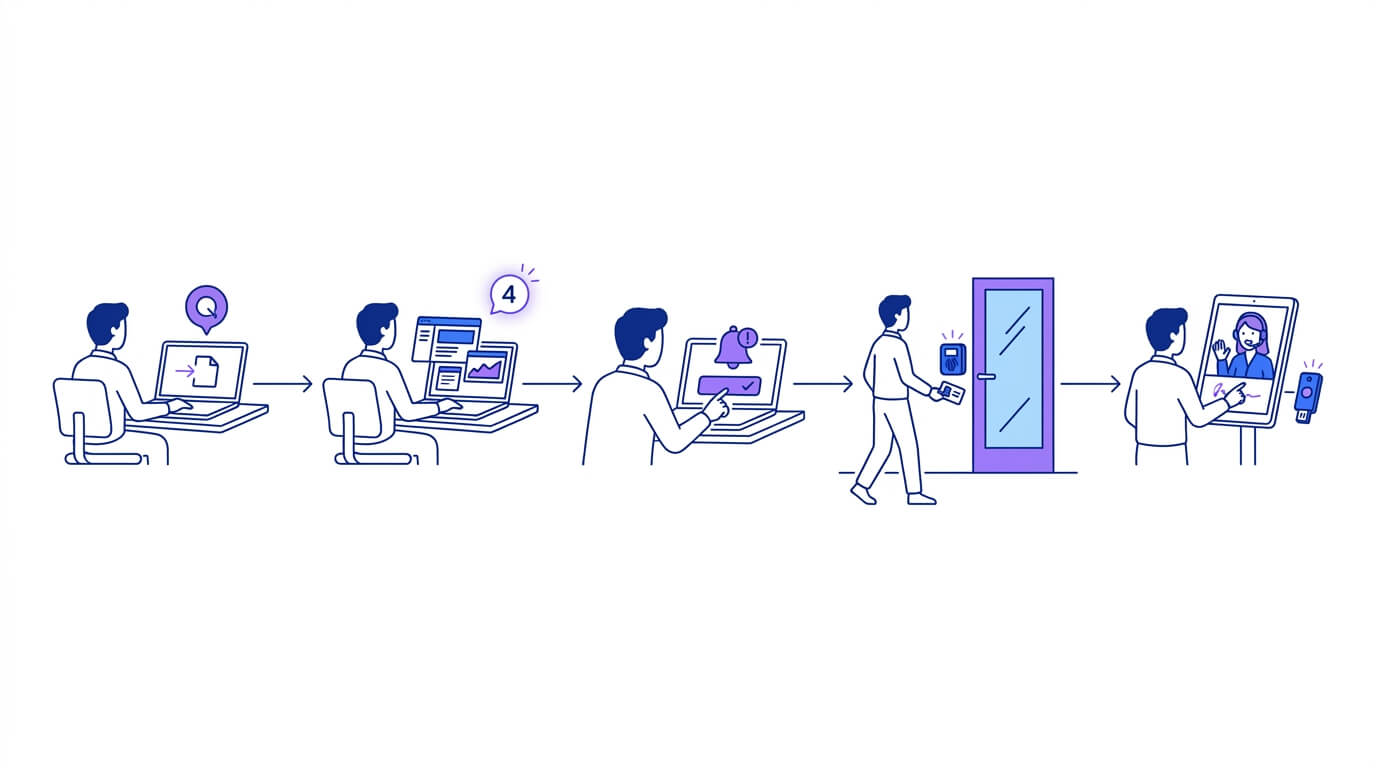
The difference this makes is not marginal. Kiosk economics are utilization economics: the station only produces assurance while a session is active. A virtual queue routinely converts the gap between sessions from minutes of hallway confusion into seconds of transition — which is the difference between clearing forty people a day and clearing sixty from the same hardware.
The Metrics That Keep an Event on Schedule
High-throughput events are run on numbers, not vibes. Administrators should track a short list of operational metrics from day one:
- Kiosk utilization rate. Active verification time versus idle time. This is the single best indicator of whether your queue discipline and staffing are working.
- Session throughput. Completed verifications per hour, per station. Trend it across days to spot drift and to forecast when the population will be cleared.
- Document readiness. The most common stall at an enrollment event is an employee arriving without acceptable evidence. IAL3 requires strong physical documents — typically a valid passport or equivalent — and carrying one is not part of anyone's normal office routine. Automated, personalized checklists sent before the event, with reminders keyed to each person's scheduled window, are the cheapest throughput improvement available. A stalled session costs you the slot and the rebooking overhead.
- Deferral and re-queue rates. A rising deferral rate usually signals a calendar conflict pattern — a standing meeting, a release window — that a small shift in event hours can absorb.
Issue Authenticators While Everyone Is in the Building
Organizations working toward FedRAMP Class D (High) or similar baselines should not waste the density an event creates. Level 3 proofing is one half of the identity story; binding a phishing-resistant hardware authenticator to that freshly proofed identity is the other. An enrollment event is the natural moment to do both: the employee completes supervised proofing, receives their security key, and the binding between verified human and issued authenticator is recorded in one continuous, dated sequence.
That single-pass model produces exactly the evidence chain an assessor asks for — proofing event, authenticator issuance, access enablement, in order, per person. We cover the mechanics in IAL3/AAL3 binding with hardware keys, and the baseline requirements in FedRAMP High Rev. 5 IAL3 requirements.
Covering the Long Tail: Remote Staff and Post-Event Hires
No event clears one hundred percent of a workforce. Some employees are fully remote, some are traveling, and hiring does not pause because an enrollment window closed. The event model works best as the high-density layer of a hybrid program:
- On-site events clear the concentrated majority at corporate and agency hubs, fast.
- Shippable verification kits and supervised remote sessions reach the distributed remainder — same platform, same IAL3 workflow, same evidence record, no travel.
- Steady-state onboarding absorbs new hires one at a time after the surge is over, so the organization never rebuilds the backlog it just cleared. Pair it with a sensible retention and re-verification policy and the finding stays closed.
Running both modes on one platform is what makes the compliance narrative clean: an auditor sees a single, consistent proofing standard and evidence format across the event population, the remote population, and every hire since. For a broader comparison of IAL3 operating models, see our guide to choosing an IAL3 solution.
From Compliance Finding to Closed Control
The reason to obsess over throughput is not operational pride — it is that every completed session is a dated, defensible evidence record, and the finding closes when the last record lands. A well-run event program produces the artifact trail a 3PAO or agency reviewer expects: who was proofed, when, against what evidence, supervised by whom, with what result.
By focusing on a friction-reduced employee experience and structured on-site workflows, enterprises can systematically deploy verification kiosks to key hubs nationwide — turning a complex regulatory requirement into a scalable, highly efficient onboarding event rather than a year of calendar Tetris.
Trust Swiftly runs this model end to end: turnkey kiosks and event logistics, live proofing agents, express walk-in and queue-managed flows, shippable kits for the remote long tail, and audit-ready evidence for every session. Explore our turnkey IAL3 verification solution and federal identity proofing programs, or talk to us about planning your IAL3 enrollment event.