FedRAMP ATO accelerators are one of the fastest ways for a software company to break into the federal market. Instead of building a compliant boundary from scratch, which is a multi-year, multi-million-dollar project, you deploy your application into a platform that already holds the boundary, the documentation, and a large share of the controls. For plenty of teams, that trade is the right one. It shortens the path to authorization, lowers the cost, and lets a small company compete in a market that used to belong to the largest cloud providers.
Every architectural decision has trade-offs, though, and this one has a quiet edge that rarely shows up on the datasheet. An accelerator can inherit your infrastructure controls, but it cannot inherit your people. The engineers who debug production, the DevOps staff who push deployments, the administrators with privileged consoles, and the support agents who touch customer data are all your identities. FedRAMP Class D (High) requires those identities to be proofed to Identity Assurance Level 3 (IAL3), and that requirement does not transfer down to the platform underneath you. Trust Swiftly works alongside ATO accelerator platforms to cover exactly that gap, applying the right verification to the right people at the right point in your authorization timeline.
One naming note before we go further. The program is mid-rebrand to FedRAMP Certification, with lettered Certification Classes standing in for the old baseline names, and Class D is the slot that holds today's High baseline. We write "Class D (High)" throughout, so it reads cleanly against the package you are building now and the wording you will be graded on next.
What an Accelerator Actually Inherits
A FedRAMP accelerator, whether it is Palantir FedStart, Second Front's Game Warden, or one of the newer FedRAMP-as-a-service boundaries, gives you a pre-authorized environment to deploy into. The platform operator runs the secure boundary: the network perimeter, the hardened infrastructure, the persistent monitoring pipeline, the physical and environmental protections of the data centers, and a long list of operational and configuration management controls. When your application lands in a compatible state, you genuinely inherit dozens of controls you would otherwise have to design, document, and defend on your own.
That inheritance is real and worth a lot. Across the major federal cloud baselines, a customer typically inherits a meaningful share of controls, mostly the physical, environmental, and network-perimeter families, and stays responsible for the rest: the application layer, customer data, customer identity, and customer-side monitoring. Inheriting that share frees a lean team to spend its energy where it actually competes: hardening the application and building real identity governance, rather than re-deriving boundary controls that the platform already satisfies.
The problem is not that accelerators fall short. It is that "deploy in a compatible state" is a claim about your software, not your people. The platform's coverage ends where its visibility ends. It does not see who you hire, who you assign to a privileged role, or whether the human behind an administrator login is who they say they are.
The Customer Responsibility Matrix Is Where the Gap Lives
Every FedRAMP certification package (formerly called the authorization package) records who implements each control, traditionally in a Customer Responsibility Matrix (CRM) and a Control Implementation Summary (CIS). Together, they are the authoritative answer to "who handles what." Each control is marked one of three ways:
- Inherited: the platform fully implements it, and you get it for free.
- Shared: the platform provides a capability, but you configure and operate your portion.
- Customer-responsible: it sits entirely with you.
When an accelerator advertises "almost complete coverage," it is describing the Inherited column, and the claim is fair as far as it goes. A diligent agency reviewer or independent assessor does not stop reading there. They work down the Customer-responsible and Shared rows line by line, because that is where the residual risk an agency has to accept lives, actually.
Proving your own personnel sits squarely in the customer column. Two control families make it explicit:
- IA-12 (Identity Proofing). Proving the people who hold accounts in your system is your job, performed at the assurance level the baseline calls for.
- IA-2 and IA-5 (Identification, Authentication, and Authenticator Management). For your privileged users, the authenticator and its binding to a real, proofed identity are yours to implement and evidence.
No accelerator signs these off for your workforce. An accelerator's operators prove their own staff, the platform engineers who run the boundary, because those are the privileged identities the platform answers for. That responsibility stops at the edge of your application. The engineer you assign to manage your deployment, the contractor you bring in to chase a production incident, and the support rep who can pull up a customer record are not the platform's identities to prove. They are yours, and the CRM says so in writing.
Class D (High) Makes IAL3 a Hard Requirement
None of this is optional at Class D (High). The baseline sets all three assurance dimensions at Level 3: how a person is proofed (IAL), how they authenticate (AAL), and how their identity is federated (FAL). It also locks them together. A Level 3 authenticator issued to someone, proofed only to Level 2, still fails because the strong token is now vouching for an identity that was never strongly established. The exact control language and the spot inside IA-5 where it tends to hide are broken down in FedRAMP High Rev. 5 IAL3 Requirements in 2026. For an accelerator customer, the takeaway is narrower and sharper: the Level 3 proofing that requirement leans on is a control you hold, not one the platform hands you.
Level 3 proofing is also a bar that ordinary HR onboarding never clears. Under NIST SP 800-63A-4, it calls for an on-site attended event: a trained proofing agent in the room, or attending through a CSP-controlled kit or kiosk, the identity document validated by its chip, by scanning technology or by the agent's physical inspection, and the person biometrically matched to that document, with the biometric retained. Mutual secrets and quiz-style knowledge checks earn no credit. So the senior engineer you set up months ago with an email invite, a password, and an authenticator-app prompt is, in FedRAMP terms, an unproven identity, no matter how locked down the accelerator's boundary is around the system they log into.
When an independent assessor reviews this, they do not take your headcount on faith. They pull a sample of privileged accounts and follow each one back to the proofing event that is supposed to sit behind it. An administrator account with no IAL3 record underneath it is a deficiency written straight against IA-12, and the depth of your inherited control set does nothing to soften it, because IA-12 was never in the inherited column to begin with. The accelerator's authorization cannot absorb a finding that the accelerator was never on the hook for. Independent Assessor IAL3 Review and Agency Approval for FedRAMP High (Class D) walks through how that sampling and evidence grading play out in practice.
The AAL3 Binding Gap That "Full Coverage" Leaves Open
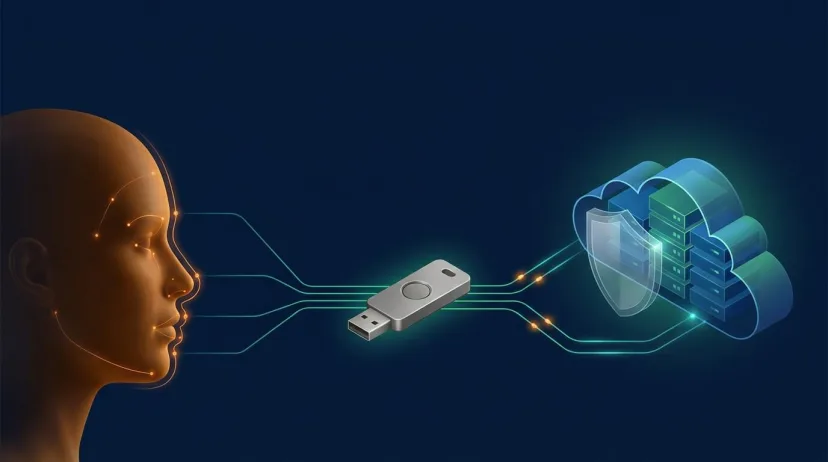
There is a quieter version of this gap, and it catches teams who believe they have already handled identity. Some accelerators do help with the technical side of AAL3. They can provision or support phishing-resistant hardware authenticators, FIDO2 security keys, smart cards, and YubiKeys, and enforce their use at login. That part is genuinely useful, and it is exactly why teams assume the identity box is checked.
Handing someone a YubiKey is not the same as proving who they are. AAL3 answers a narrow question: "Is a strong authenticator present at sign-in?" IAL3 answers a different one: "Is the human holding it actually the person we think it is?" The step that ties those two answers together, binding an AAL3 authenticator to an IAL3-proofed identity, is the one no accelerator runs for you. The platform can ship the token and enforce its use. It cannot sit a person through a supervised proofing session, validate their evidence cryptographically or biometrically, and record the link that proves the token belongs to a verified human.
That link, the recorded fact that this verified person holds this specific authenticator, is the connective tissue between IAL3 and AAL3, and it is yours to produce and defend. The full proof, issue, and enable lifecycle, including what a clean record looks like, is laid out in FedRAMP Class D (High) IAL3/AAL3 Binding with YubiKey. The trap for accelerator customers is assuming the token is the binding. It is only half of it. A drawer of issued YubiKeys with no proofing events tying each one to a verified individual is an AAL3 story missing its IAL3 chapter.
Don't Forget Support, Help Desk, and Contractors
The instinct is to scope IAL3 to "the engineers," and that scope is too narrow. The question a reviewer asks is not "who is on the platform team." It is "who can reach the data or the controls," and that population runs wider than most onboarding flows assume:
- Support and help-desk staff who can view, export, or change customer records, reset accounts, or impersonate users to troubleshoot.
- Contractors and short-term engineers brought in for a single incident, who tend to get elevated access the fastest and are proven the slowest.
- Site reliability and DevOps staff whose pipelines and break-glass paths are privileged surfaces in their own right.
Any of these roles can grant privileged access on a Class D (High) system, and every individual in them must complete IAL3 before holding that access. This is also where insider-threat and remote-worker fraud risk tends to concentrate. An unproven support account with broad data visibility is precisely the foothold a fabricated identity seeks. We dig into that threat model in Leading Techniques for Detecting Insider Threats and Fake IT Workers.
How Trust Swiftly Closes the Gap Alongside Your Accelerator
The right model is not "accelerator or identity provider." It is both layered on purpose. The accelerator owns the boundary and the large block of inherited controls. Trust Swiftly owns the IAL3 layer for your workforce and the binding that makes your AAL3 authenticators defensible. We sit atop an accelerator's coverage rather than compete with it.
In practice, that means:
- On-site attended IAL3 proofing at the office or a home office, on a Trust Swiftly-controlled kit with the agent attending over video, for your engineers, administrators, support staff, and contractors, without flying everyone to a field office.
- IAL3-to-AAL3 binding that records the proofing event, ties it to the issued hardware authenticator, and switches on privileged access only after proofing closes, leaving the dated, ordered record that an assessor will ask for.
- Audit-ready evidence packages scoped to the CRM rows you actually own, so you can answer IA-2, IA-5, and IA-12 row by row with artifacts instead of assurances.
- The right scope at the right time. We help you work out which roles fall inside the Class D (High) privileged-user boundary and sequence proofing so it lands before access is granted, not after a finding forces a scramble.
Because the accelerator has already absorbed the boundary controls, this is a focused involvement rather than a ground-up build. You spend what is left of your effort on the things only you can do, hardening your application and governing your own identities, and the inherited share stops being a place where hidden obligations sit waiting. For privileged-access framing across baselines, see FedRAMP Moderate IAL3 for Privileged Access and the wider Federal Identity Proofing overview.
The Bottom Line
FedRAMP accelerators are a strong choice, and for many teams, the correct one. They are not a complete identity solution, though, and they never claimed to be. The Customer Responsibility Matrix draws a clear line. The platform inherits the boundary, and you keep the proofing of your own people. Class D (High) turns that retained piece into a hard requirement: IAL3 proofing and an IAL3-bound AAL3 authenticator for every privileged user, including the support and contractor roles onboarding likes to forget.
Assume the accelerator covers everything, and a thorough agency will find the gap for you. Treat the inherited controls as the foundation they are, put a deliberate IAL3 program on top of them, and the same review turns into a straightforward evidence handoff instead of a scramble.
Deploying on a FedRAMP accelerator and need to close the IAL3 gap for your own staff? Contact Trust Swiftly to map your privileged-user population to the CRM controls you own and stand up IAL3 proofing and AAL3 binding before your assessment does it for you.
Run a FedRAMP accelerator or advise teams on one? See how we work with FedRAMP accelerator partners.