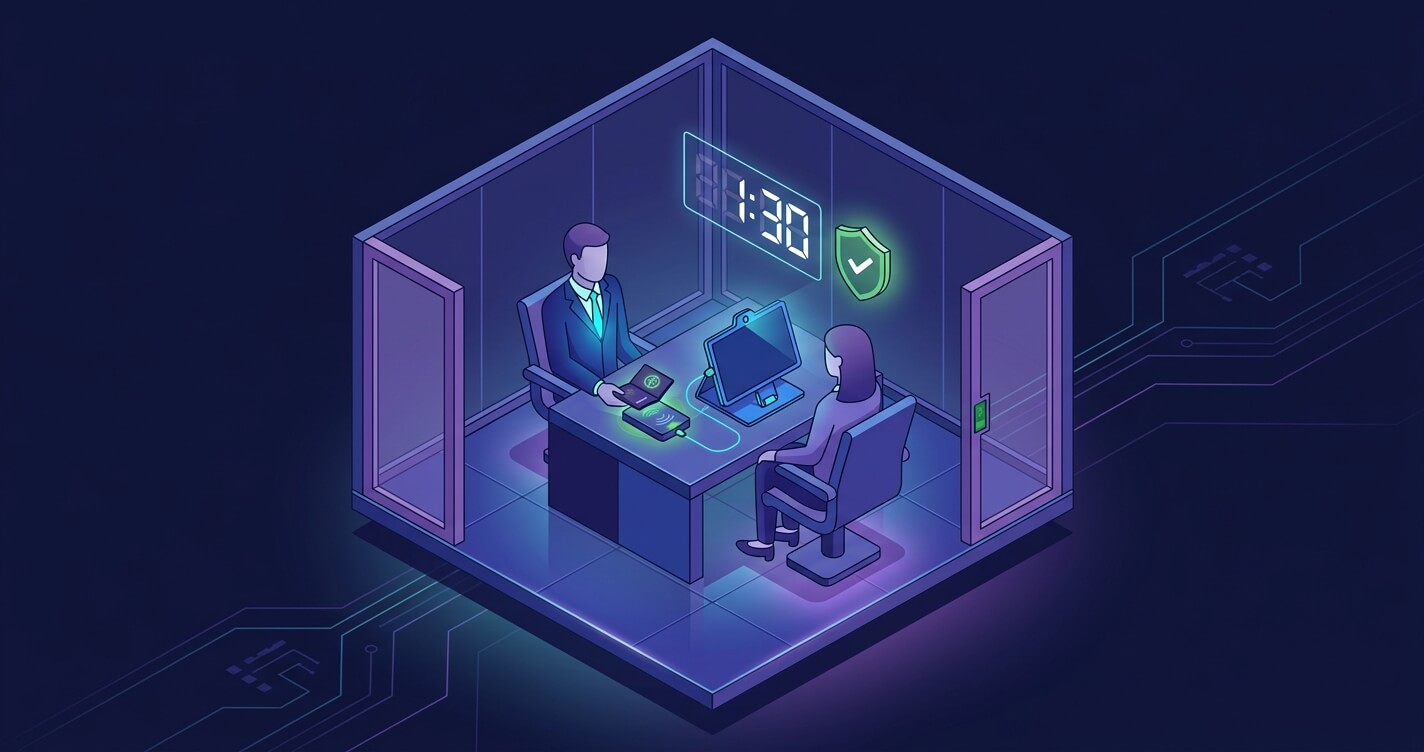
Today we are introducing Trust Swiftly Velocity Concierge™ — a premium, white-glove identity proofing service that brings a trained Trust Swiftly proofing agent and our controlled verification hardware directly to your site. It is the fastest NIST IAL3 workflow we have ever offered, with the attended capture ceremony completing in about two minutes per person, back to back, all day long.
Remote supervised IAL3 is excellent, and it remains the right default for a distributed workforce. Those sessions use Trust Swiftly-controlled equipment with an embedded camera, including when an employee completes the session from home — not a personal webcam or unmanaged device. But there are moments — a compliance deadline covering hundreds of people in one building, a new site launch, a merger, an executive cohort — where nothing beats a real human in the room with purpose-built equipment. Velocity Concierge is our answer for those moments: security, speed, and a genuinely pleasant user experience, delivered together instead of traded off against each other.
Planning to verify 100 or more people? Request a Velocity Concierge event and throughput plan.
Where the Minutes Go in Remote IAL3 — and How a Concierge Gets Them Back
A typical remote supervised IAL3 session takes around five minutes. Almost none of that time is spent on the actual checks. Document authentication, chip reads, biometric matching, and authoritative-source lookups are fast. The time goes to everything around them:
- Novelty. For most people, high-assurance proofing is a first-time experience. They have never presented a passport to an NFC reader, never done a supervised liveness check, and never navigated a proofing ceremony. Every step needs explanation before it can be performed.
- First contact with the device. Even on our pre-configured kits, a first-time user spends time orienting: where to look, where to place the document, how close to stand. Familiarity is throughput, and by definition a first-time user has none.
- Environmental friction. Lighting, glare on a laminated card, a worn document that needs repositioning, a camera at a bad angle for at-home sessions.
- Network latency. A supervised session is a live, bidirectional video ceremony. Round-trip lag between the applicant and a remote agent adds seconds to every instruction, and a congested guest network can add much more.
- Queueing. Remote agents are a shared pool. Under normal load, waits are short; when three hundred people from the same company try to verify in the same week, the queue itself becomes the bottleneck.
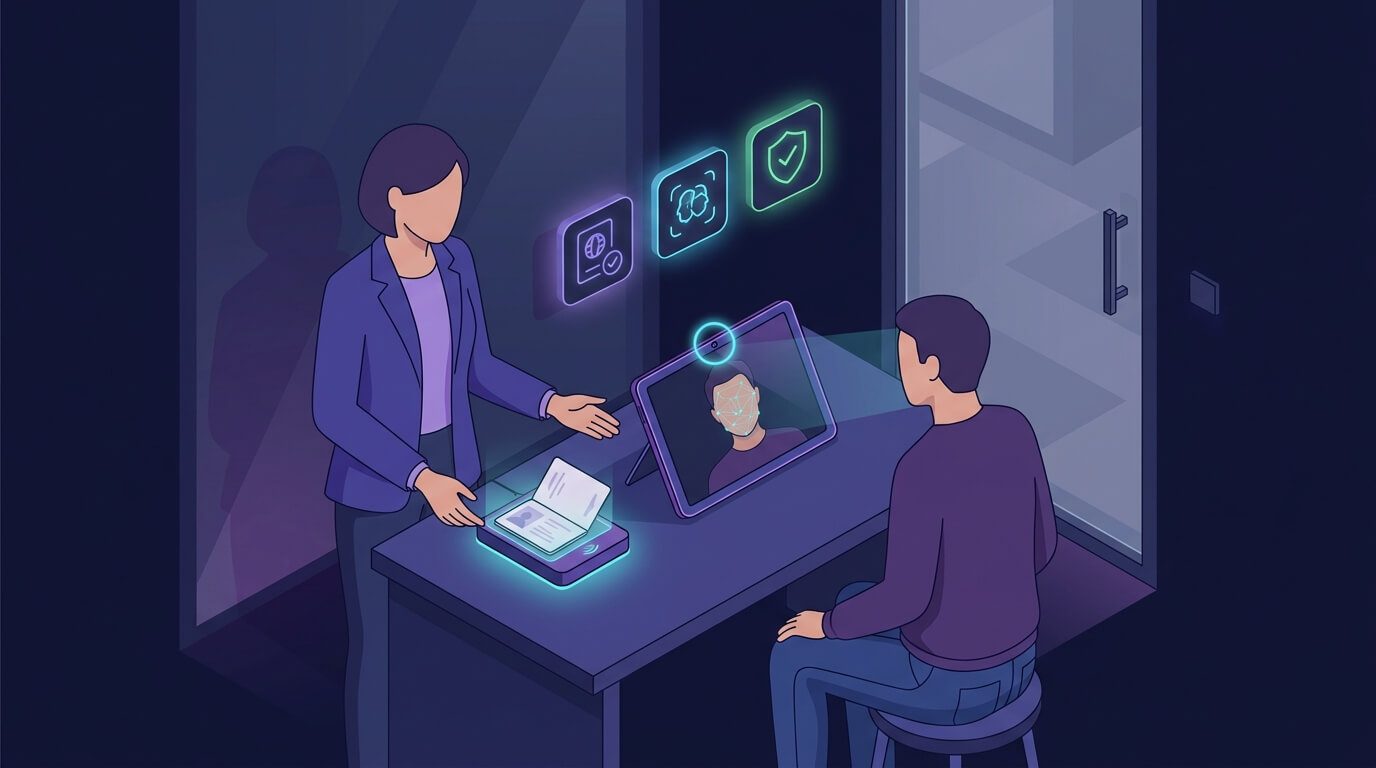
A co-located agent collapses all five categories at once. The agent greets the applicant, takes the document, places it on the reader correctly the first time, positions the person for biometric capture, and narrates the ceremony as it happens. There is no video lag because there is no video link to the supervisor — supervision is standing right there. There is no retry loop because the person operating the equipment has done this thousands of times. Before the event, each applicant receives a clear checklist of the identity evidence required for their proofing pathway; on the day, they bring that evidence and the concierge handles the equipment and ceremony.
The result is a ceremony that routinely finishes in 60 to 120 seconds, with a near-zero retry rate — because the leading causes of retries are user-side variables that a concierge removes from the equation entirely.
Fully Aligned with NIST SP 800-63-4 On-Site Attended Proofing
The finalized NIST SP 800-63A-4 guidelines modernized IAL3 around attended identity proofing: a trained proofing agent interacts directly with the applicant, validates identity evidence to its strongest available features, and biometrically binds the person to the evidence they present. The guidelines support two attended pathways — a remote agent supervising a session on controlled hardware, and an on-site, co-located proofing agent.
Velocity Concierge is a first-class implementation of the on-site attended pathway, and it deliberately does not cut any corners the remote path takes seriously:
- Same controlled hardware. The agent carries the same hardened, pre-configured verification kit used in our supervised kiosk deployments — document authentication with chip-level (NFC) evidence validation, high-fidelity biometric capture, and tamper-evident handling. This is not an agent eyeballing a driver's license; every cryptographic and biometric check in our standard IAL3 flow still runs.
- Trained proofing agents. Our on-site agents are trained to the same CSP proofing-agent standards as our remote supervisors, including evidence examination, presentation-attack awareness, and privacy handling.
- Identical evidence and audit trail. Sessions produce the same audit-ready record as any other Trust Swiftly IAL3 verification — same evidence retention, same reporting, same webhooks into your systems. Your compliance posture does not change based on which pathway a given employee used.
- Independent acceptance. The Trust Swiftly IAL3 program has been reviewed and accepted by multiple independent 3PAOs and government agencies in customer assessment and authorization contexts.
Security That Only Physical Presence Can Provide
We have written before about the vulnerabilities in IAL3 and identity verification systems, and the honest summary is that the hardest remote attacks all live in the capture path: camera injection, virtual devices, replayed or synthesized video, and increasingly capable deepfakes. Controlled hardware and attack detection close most of that surface. Physical co-location eliminates it.
With a proofing agent in the room:
- There is no injection vector. The biometric sample is captured by our hardware, from a person the agent is looking at. Feed injection and deepfake presentation are not "mitigated" — they are structurally impossible.
- Presentation attacks meet a human. Masks, appearance alteration, document overlays, and coached impostors are dramatically easier to detect at arm's length than through a camera. A trained agent notices the things a camera cannot: texture, behavior, hesitation, a second person hovering.
- The whole scenario is supervised, not just the frame. A remote supervisor sees what the camera sees. An on-site agent sees the room — who accompanied the applicant, whether someone is being directed or pressured, whether the document came out of a wallet or an envelope of documents. That situational oversight is a fraud signal no remote session can replicate.
- Exceptions are identified and routed immediately. A worn passport, a recent legal name change, or a document with a chip that will not read does not have to become an open-ended support ticket. The on-site agent identifies the issue, applies documented alternate-evidence procedures when permitted, or routes the applicant into the appropriate exception process.
The Concierge Experience: Verification as Hospitality
Security teams buy assurance levels. The people being verified experience something else entirely — and at most organizations, IAL3 proofing lands on exactly the population you least want to frustrate: executives, cleared engineers, busy managers, new hires on day one.
Velocity Concierge is designed to make the most rigorous identity check most people will ever go through feel like a hotel check-in:
- Simple preparation. No camera review or "use a well-lit room" email. Employees receive a clear checklist and bring the identity evidence required for their proofing pathway; the concierge handles the equipment.
- A human welcome. The agent explains what is happening and why, answers questions on the spot, and handles the equipment. Nobody is left alone fighting a device.
- No technical anxiety. The applicants who struggle most with remote proofing — people uncomfortable on camera, less familiar with technology, or simply busy — are the ones a concierge helps most. Accessibility needs are accommodated by a person, in person.
- About two minutes, then back to work. For a workforce being verified on company time, the difference between a five-minute ceremony with a possible retry and a standard ceremony completed in about two minutes, multiplied by hundreds of people, is measured in workdays.
That experience is also a message. When a company brings a concierge on-site instead of sending only a link in an email, it tells employees that security is something the organization does for them, not to them.
Built for High-Volume Events
Velocity Concierge is a premium engagement, and we are direct about why: we fly a trained proofing agent and equipment to your site. That cost profile makes it the wrong tool for steady-state trickle verification — and precisely the right one for concentrated, high-stakes events:
- Compliance remediation cohorts — an audit or 3PAO finding puts hundreds of staff on a proofing deadline measured in weeks.
- Site launches and office openings — verify an entire building's population during onboarding week.
- Mergers and acquisitions — bring an acquired workforce to your assurance baseline in days.
- Government and defense subcontractor badging — cleared or ITAR-scoped populations that need high-assurance proofing before program access.
- Healthcare cohort onboarding — waves of travel nurses or physicians who cannot afford failed sessions between shifts.
- Executive and VIP verification — where a premium, white-glove experience is simply the expectation.
The throughput math is straightforward. At one to two minutes per ceremony, a single concierge station sustains 25 to 40 verifications per hour — 200 or more in a working day, per station — with no queue pool contention and no retry tail. Compare the pathways side by side:
| Comparison | Remote Supervised IAL3 | Velocity Concierge (On-Site) |
|---|---|---|
| Typical session time | ~5 minutes | 1–2 minutes |
| User preparation | Controlled-kit orientation, lighting, positioning | Review checklist and bring required identity evidence |
| Common failure modes | Glare, lighting, network lag, first-time confusion | Rare — agent operates the equipment |
| Injection / deepfake surface | Mitigated by controlled hardware and detection | Eliminated by physical presence |
| Exception handling | Retry or reschedule | Triaged or routed on-site |
| Presence check | Camera frame | Full-room human oversight |
| Cost profile | Efficient at any volume | Premium; efficient at event volume |
| Best for | Distributed workforce, ongoing hiring | Concentrated cohorts, deadlines, VIP populations |
For the broader playbook on planning cohort-scale enrollment — scheduling waves, virtual queuing, and express walk-in flows — see our guide to scaling IAL3 verifications for mass onboarding. Velocity Concierge slots into that model as the highest-throughput, highest-touch tier.
The Verification That Comes to Your People
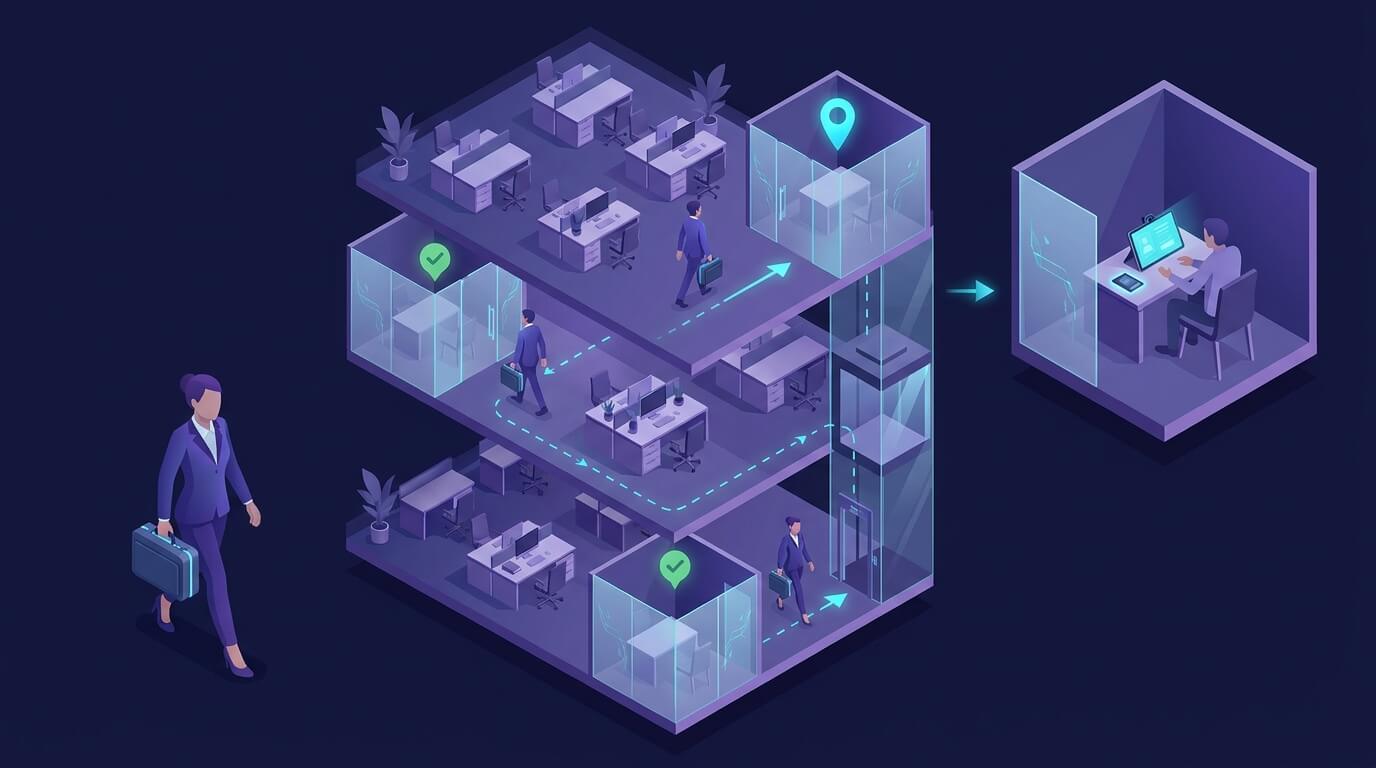
A detail that surprises customers: the concierge station is mobile, and the agent expects to move it.
Because a Trust Swiftly agent is on-site with the kit, verification can go where your people are instead of the reverse. Morning session in the engineering building, afternoon in the clinical wing; day one on the third floor, day two on the seventh. The agent relocates and re-verifies the equipment between sessions, so a multi-floor or multi-building campus gets coverage a fixed kiosk never could — and employees verify steps from their desks instead of trekking across a campus and losing half an hour.
The on-site agent also acts as real-time technical support for the deployment itself. Hardware checks, connectivity fallbacks, consumables, positioning, signage, queue flow — everything that generates a support ticket in an unattended deployment is handled quietly in the moment, before anyone in line notices. Uptime during your event is a person's job, not a monitoring dashboard's.
After the Event: A Hybrid Program, Not a Dependency
We will be honest about the operating model, because it is the same advice we give every Velocity Concierge customer: use the concierge for the spike, then switch to remote for the steady state.
An on-site engagement is the fastest way to verify a large population in one pass. It is not an economical way to verify next month's three new hires. After the event, stragglers and ongoing hiring flow into our remote supervised IAL3 verification — same evidence standards, same audit trail, no travel required. For offices with recurring walk-in volume, a permanently installed express kiosk bridges the two. Because every pathway runs on the same platform, a person verified by a concierge in July and a person verified remotely in August are indistinguishable in your compliance reporting.
That is the program design we recommend: concierge for launches, deadlines, and VIPs; remote for everyone, everywhere, always-on.
Frequently Asked Questions
Is on-site concierge verification actually IAL3, or a convenience add-on?
It is full IAL3. NIST SP 800-63A-4 explicitly supports on-site attended proofing by a trained agent, and Velocity Concierge runs the complete Trust Swiftly IAL3 flow — chip-level document validation, biometric binding, and authoritative-source checks — on the same controlled hardware as our supervised deployments, producing the same audit evidence. The Trust Swiftly IAL3 program has been reviewed and accepted by multiple independent 3PAOs and government agencies as an approved solution.
How fast is it really?
Most ceremonies complete in 60–120 seconds. The checks themselves were never the slow part of IAL3 — user-side friction was, and a concierge removes it. Allowing for participant transitions, equipment checks, and occasional exceptions, a station sustains approximately 25–40 completed verifications per hour.
Why does it cost more than remote verification?
Because a trained proofing agent travels to your site with verification hardware and staffs your event in person. That premium buys throughput, a near-zero failure rate, physical-presence security, and a white-glove employee experience. For concentrated events, the per-verification economics are strong; for ongoing trickle volume, remote supervised sessions are the better value — and we will tell you so.
How large does an event need to be?
Engagements typically make sense from around a hundred verifications over one to three days, though executive and VIP engagements can be much smaller. Multi-station deployments scale to thousands across a week.
What does our team need to provide?
For an engagement inside your facility, we need a private or access-controlled space that meets the service's physical-security and privacy requirements, a power outlet, network access (the kit carries its own connectivity fallback if 5G is available), and a schedule of participants. If you prefer a hosted nearby location, we will arrange the approved space with you. In either model, the agent handles the equipment and station operations.
Does verification have to take place inside our building?
No. Velocity Concierge can operate inside an approved customer facility, in a private nearby space arranged by Trust Swiftly, or at another mutually acceptable location. Every location must pass the same site-readiness review and provide an access-controlled setting that meets our physical-security, privacy, power, and connectivity requirements. This gives organizations with strict visitor or facility-access policies the same white-glove experience without bringing an outside agent into a sensitive building.
How is applicant information protected?
Velocity Concierge applies the same privacy, consent, encryption, retention, and access-control policies as our other IAL3 deployments. Before proofing begins, applicants receive notice about the personal information and biometrics collected, why they are required, how they are used, the applicable retention period, and the available redress process.
Can we combine concierge and remote verification in one program?
Yes — that is the recommended design. The concierge clears the initial cohort; remote supervised sessions cover remote employees, stragglers, and ongoing hiring. Both produce identical records in your dashboard and reporting.
Bring Velocity Concierge to Your Workforce
Whether the engagement takes place in your facility or at a secure nearby location, we will help select the venue, size the deployment, choose the right number of stations, and build a schedule around your workforce.
Request a Velocity Concierge event and throughput plan.